Beloved, Unfinished, Hungry
“I give you a new commandment, that you love one another”. Maundy Thursday is the culmination of what has been bubbling under the surface of Jesus’ whole ministry - that he is introducing a new way of relating to God. That God has a new way of relating to us. The story everybody knows about God’s relationship with Abraham, Isaac, and Jacob, the connection between God and his chosen people Israel, is changing. It is expanding. It is breaking open.
The disciples are used to the language of covenant. It encapsulates their faith. In the language of the Old Testament a covenant is not only a contract, but it is about belonging. It’s about promise, fidelity, love and relationship. Again and again through the story of God’s people, covenant is the way God binds Godself to human beings who are fragile, inconsistent, and beloved. There is the rainbow after the flood; the promises to Abraham; the blood of the Passover; the law given to Moses; the repeated call to remember that God and people are bound together. The covenant with God is what all the existing commandments are based on. But tonight, Jesus introduces a new commandment, and a new covenant.
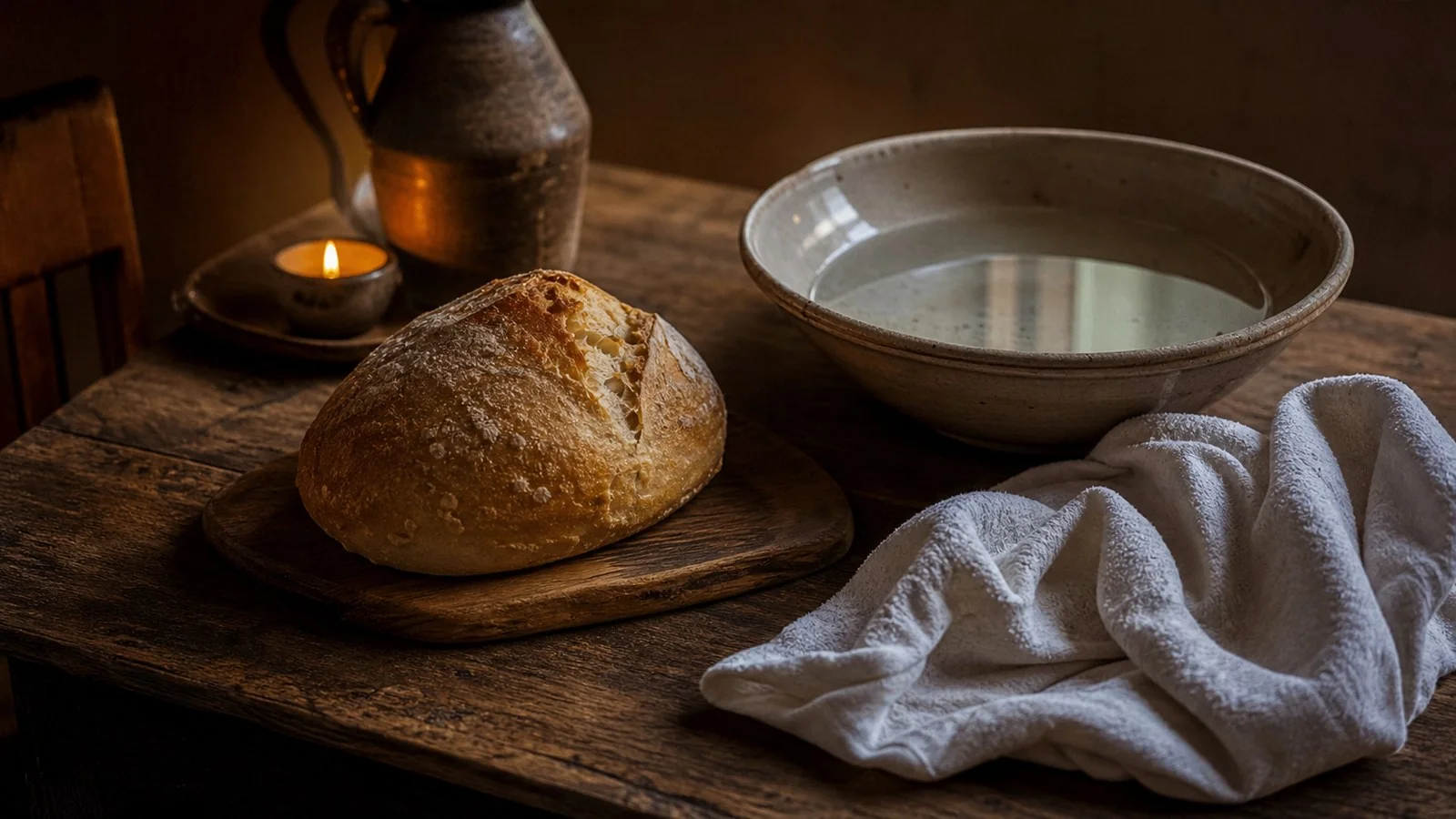
If you are a bit squeamish about your feet, or shy away from the idea of someone else seeing them, touching them, washing them, you have arrived at why Maundy Thursday is so powerful. Foot washing is uncomfortable! It feels vulnerable and perhaps embarrassing. But Jesus is introducing a new covenant based on love, where our whole selves are accepted, and where our whole selves are offered. This new covenant asks us to let Christ come near to the dusty, tired, ordinary parts of us, as well as the nicely exfoliated, dressed, and decorated.
So what else does this new covenant bring? What’s the difference in a commandment to love one another? Well, notice whose feet Jesus washes. Not only the feet of the faithful disciples. Not only the least annoying. Not only the ones who will be persistently loyal until morning. No. Instead Jesus washes the feet of the bewildered, the proud, the fearful, the soon-to-be deserters, and even the betrayer. He washes all of their feet, because covenant love is not fragile. It does not evaporate the moment human beings fail. Instead the love of God in Christ remains astonishingly close, even in the very hour when that love is being refused.
‘You will never wash my feet’ declares Peter, the impulsive, passionate Peter who is about to deny that he even knows who Jesus is. ‘Oh yes I will’ says Jesus. Because this is love that can’t be put off or deterred. This is love that persists through even the most disastrous human moments. This is the new covenant.
Then, what comes next after the foot washing, is the institution of the Eucharist. Jesus sits with his tired, argumentative, hungry disciples, takes bread, blesses it, breaks it, and gives it to them. He takes the cup and tells them that this is the new covenant in his blood. In that same room is Judas, who has already betrayed him. Peter is only hours away from denial. The others are confused, frightened, and not nearly as faithful as they would like to imagine. And still Jesus gives himself to them. This is what the new covenant looks like: grace offered before understanding, love given before it is deserved, relationship held open even as hearts begin to close.
This is what we have inherited. This is our covenant. This is the relationship with God we have been gifted. The Eucharist is integral to our faith because week by week, we don’t come to the table as people who have got it all sorted out. We come with hunger, distraction, grief, with gratitude, hope, regret, and with all the tangled things that make us human. And Christ meets us there. The bread and wine are not a prize for the spiritually impressive. They are grace that can be touched and tasted. In our remembrance and celebration we stretch out our hands alongside neighbours, strangers, dear ones, and people we may not understand at all. One loaf. One cup. One body.
Our world is one which is determined to sort, rank, and divide, but the altar tells a different story. Footwashing tells a different story. We belong to Christ, and therefore we belong to one another. The new covenant is not simply that God forgives individuals. It is that God is creating a people shaped by love.
So yes, Maundy Thursday can feel uncomfortable, especially if you forgot to get that pedicure beforehand. But today we are asked to accept that the God we worship is not a God who keeps a careful distance, but a God who comes near enough to wash feet, feed friends, and endure betrayal. That kind of love is not tidy. But it is real, it is close, and it is holy. And this is the love we pour ourselves into imitating.
Tonight we come to be washed, and we come to the table, as we are: beloved, unfinished, and hungry for God. We bring our empty hands and our ordinary feet, and here Christ meets us. In the bread and wine, he says: I give myself to you. In the water and towel, he says: this is how to give to one another. And in both, he says: abide in my love. Live in this new covenant. Become this commandment to love, for one another and for the world. Amen.
1 Corinthians 11:23-26; John 13:1-17, 31b-35